
Procuring cost-effective computing hardware often forces IT decision-makers, small business owners, and budget-conscious consumers into a complex decision-making matrix within the secondary technology market. A pervasive issue in this space is that many buyers treat the terms “used” and “refurbished” as completely interchangeable synonyms. This fundamental misunderstanding frequently leads to vulnerable IT deployments, blown procurement budgets, and catastrophic hardware failures shortly after deployment.
The absolute distinction between these two categories lies in operational verification, professional engineering oversight, and strict quality control. While a standard used computer is passed along to the next buyer with its operational history, hidden physical flaws, and data baggage completely intact, a certified refurbished system undergoes a rigorous, multi-stage restoration process designed to reset its performance baseline to factory standards. Understanding these structural and operational variations is critical to maximizing return on investment (ROI) and ensuring data security.
Used vs. Refurbished: The Operational Divide
Purchasing unverified used laptops or desktops from private online marketplaces introduces severe, unpredictable hardware risks. These peer-to-peer transactions completely lack technical auditing, component diagnostics, or quality control protocols. Critical structural liabilities—such as microscopic motherboard corrosion from past environments, degraded lithium-ion battery cells, failing voltage regulators, and hidden liquid damage—frequently surface only after the transaction is finalized. Furthermore, private sales provide zero legal consumer protections, no return windows, and absolutely no technical support infrastructure to assist with deployment hurdles.
In stark contrast, an enterprise-grade refurbished desktop PC or laptop completely mitigates these deployment risks. Certified refurbishers process decommissioned corporate hardware through strictly controlled engineering environments. Every single component is systematically benchmarked, analyzed, repaired, and certified before ever reaching the retail market, turning an unpredictable gamble into a reliable IT asset.
| Operational Metric | Standard Used Hardware | Certified Refurbished Hardware |
| Testing Regimen | None (Basic visual inspection only) | Full diagnostic loop & hardware stress tests |
| Internal Hygiene | Accumulated dust, debris, and pet dander | Ultrasonic cleaning & fresh thermal paste application |
| Data Integrity | Manual, unverified file deletion | NIST SP 800-88 compliant data sanitization |
| Component Replacement | Broken components left as-is | Failed or degraded parts replaced with OEM-grade components |
| Buyer Protection | Caveat emptor (Strictly sold as-is) | Contractual, legally binding hardware warranty |
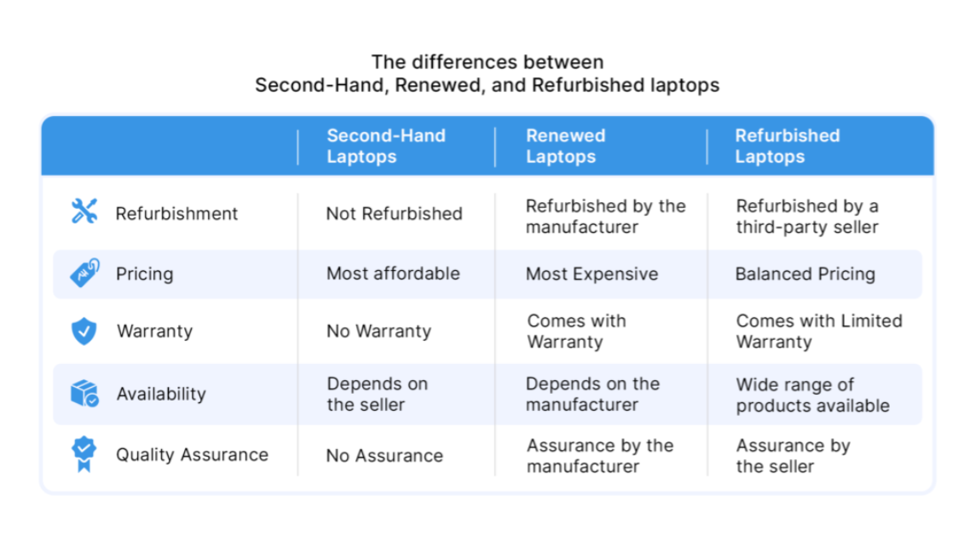
The Certified Refurbishment Quality Checklist
A professional engineering lifecycle ensures that a refurbished system performs identically to a brand-new machine out of the box. Every system must clear rigid validation protocols before being cleared for deployment:
- Component Diagnostic Testing: Technicians execute comprehensive read/write stress tests on the RAM blocks, CPU cores, and storage sectors to weed out intermittent hardware faults, bad memory sectors, or voltage instabilities under heavy workloads.
- Thermal Management Overhaul: Systems undergo comprehensive internal dust extraction using specialized pneumatic equipment. Technicians scrape away dried, brittle original equipment manufacturer (OEM) thermal paste and apply high-grade thermal compounds to eliminate processor throttling, lower fan acoustics, and optimize long-term heat dissipation.
- Power System Verification: For mobile form factors, battery capacities are digitally audited via specialized firmware tools. Battery packs holding less than 80% of their original design capacity are entirely discarded and replaced with brand-new cells to guarantee adequate untethered runtime.
- Data Sanitization and OS Deployment: Storage drives are completely overwritten using NIST SP 800-88 compliant sanitization methods to ensure total data destruction from previous owners. Defective or slow mechanical drives are replaced with lightning-fast Solid State Drives (SSDs) loaded with a clean, legally licensed operating system image entirely free of intrusive consumer bloatware.
- Contractual Warranty Coverage: Certified units carry a formal, legally binding hardware warranty, protecting the buyer from component failure for anywhere from 90 days to a full calendar year, backed by dedicated technical support teams.
Form Factor Architecture: Desktops vs. Portables
Form factors directly dictate hardware longevity, thermal profiles, and mechanical degradation rates over time. Laptops inherently suffer massive physical stress due to their mobile nature. Daily transport leads to micro-flexing of the motherboard, structural hinge wear, display degradation, and potential impact damage to internal connections. Furthermore, their cramped internal chassis subject delicate silicon to higher sustained operational temperatures, accelerating component degradation and limiting sustained peak performance.
Conversely, an investment in a premium refurbished desktop PC offers immense component longevity. Desktop processors and motherboards operate in fixed, stable environments, meaning they experience significantly less physical fatigue and mechanical shock over their operational lifecycles.
Furthermore, desktop chassis provide spacious internal layouts with superior airflow and straightforward structural access. This highly modular design enables effortless, cost-effective upgrades down the line. If an organization’s computing needs scale, technicians can easily swap out RAM modules, install high-capacity storage drives, or insert dedicated graphics cards without discarding the entire machine. For organizations looking for high-yield, budget-conscious workstations, the desktop format represents an incredibly stable, long-term computing asset.
Conclusion: Eliminate the Pre-Owned Gamble
Choosing professional refurbishment over the peer-to-peer marketplace means choosing predictable engineering outcomes over sheer luck. It successfully bridges the gap between low-cost acquisition and enterprise-grade reliability, delivering secure computing environments at a fraction of standard retail pricing.
Ready to secure dependable hardware for your workstation? [Browse our certified inventory of rigorously tested refurbished desktop and laptop solutions today.] Every machine arrives fully optimized, sanitized, and protected by our comprehensive corporate hardware warranty.