
Should You Buy a Laptop New or Choose a High-End Pre-Owned Model?
Prioritizing a factory box seal over physical material quality is a common consumer trap. Buyers frequently compromise on processing speed and structural longevity just to own an untouched, entry-level retail system. However, a premium, high-end pre-owned computer heavily outperforms and outlasts an ultra-budget, plastic brand-new model at identical price points.
True technology value relies on component grading, manufacturing quality, and architectural tiering, not the production calendar date. Making an informed choice requires breaking down the core engineering realities of consumer retail versus commercial-grade enterprise hardware.
The Build Quality Disconnect: Premium vs. Entry-Level New
A massive engineering gap separates low-end consumer retail hardware from premium structural tiers. Cheap, brand-new retail machines rely on severe structural shortcuts to hit aggressive price targets. These cost-cutting systems feature flexible polycarbonate plastic enclosures, fragile display hinges anchored into weak plastic mounts, and highly restricted input/output ports.
Under daily transport and regular use, these plastic frames flex, putting physical stress on the internal motherboard layers and frequently causing premature solder joint failures.
Conversely, the decision to buy a used laptop from an enterprise or premium creative tier completely changes your hardware trajectory. Flagship systems utilize magnesium-alloy internal frameworks, aerospace-grade carbon-fiber panels, and precision glass trackpads. These materials provide exceptional chassis structural integrity.
They are meticulously engineered to endure rigorous long-term travel, intense daily handling, and heavy operational wear without structural failure or cosmetic breakdown.
[Budget Retail New] ➔ Polycarbonate Frame ➔ Flexing Chassis ➔ Solder Joint Failures ➔ Short Lifespan
[Premium Pre-Owned] ➔ Magnesium Alloy ➔ Rigid Integrity ➔ Industrial Durability ➔ Extended Lifespan
Symmetrical Performance Realities
Silicon engineering reveals a stark performance divide between entry-level new hardware and slightly older flagship chips. Marketing departments often hype current-generation labels, masking weak architectural specifications underneath. When comparing raw capabilities, the older flagship consistently wins the processing battle:
- Flagship Architecture: A two-generation-old flagship processor (such as an Intel Core i7 or AMD Ryzen 7) handles complex multi-threaded workloads, data compilation, and heavy multitasking effortlessly due to wider pipelines and superior multi-core design.
- Economy Silicon: Brand-new economy processors (like Intel Celeron, Pentium, or basic i3 chips) suffer from restricted cache sizes, lower core counts, and throttled operating frequencies.
- Thermal Dynamics: Budget new laptops skimp on cooling, utilizing tiny passive heatsinks that cause the CPU to instantly throttle down under load. Premium chassis designs feature robust copper heat pipes and dual-fan arrays to maintain high clock speeds during sustained processing.
- System Memory: Budget new systems frequently feature soldered, non-upgradable RAM (often capped at an restrictive 4GB or 8GB) that severely limits future software compatibility. High-end pre-owned systems typically offer modular slots for easy, cost-effective memory expansion.
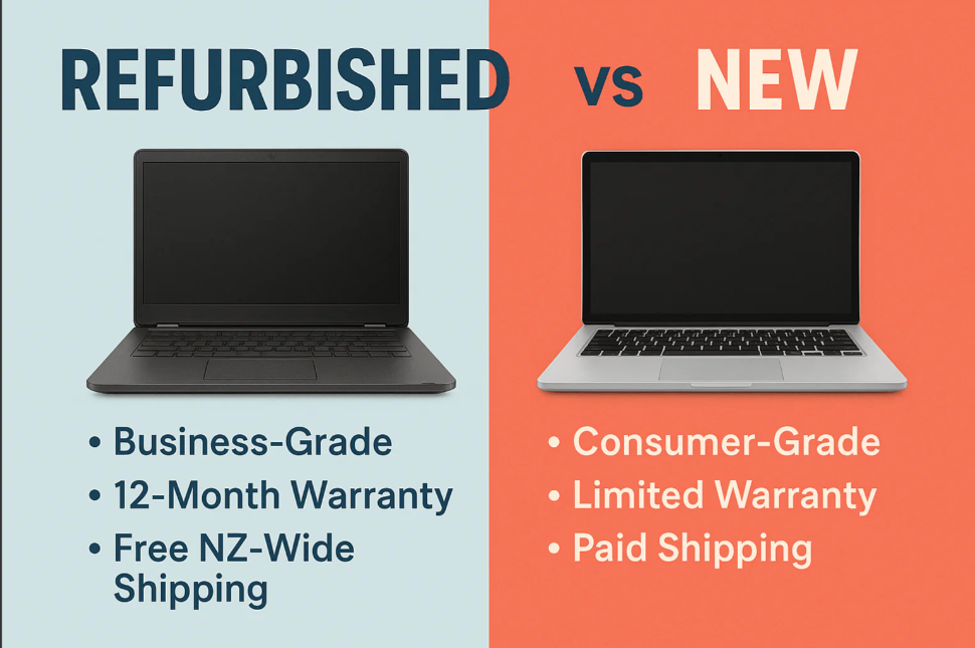
Technical Allocation Matrix
To fully visualize how your capital stretches across these two acquisition paths, evaluate this head-to-head comparison of standard specifications at identical price boundaries:
| Design Feature | Budget Retail New Laptop | High-End Pre-Owned Laptop |
| Chassis Materials | Polycarbonate Plastic | Magnesium-Alloy / Carbon-Fiber |
| Processor Tier | Low-tier Economy (Celeron/i3) | Flagship Performance (Core i7/Ryzen 7) |
| Cooling Architecture | Minimalist Passive Heatsink | Active Dual-Fan Copper Heat Pipes |
| Display Panel Quality | Dim, Low-Contrast TN Matrix | High-Brightness, Color-Accurate IPS |
| Upgrade Paths | Soldered, Non-Expandable Parts | Modular, Swapable RAM & Storage |
⚠️ The Windows 11 Compatibility Boundary: When sourcing high-end pre-owned hardware, you must ensure your device is ready for modern software lifecycles. Microsoft has officially terminated standard support for the older Windows 10 platform. To ensure you receive critical, automated security updates without paying for expensive extended support patches, verify that your pre-owned laptop features an official Windows 11 compliant processor—specifically an 8th-Generation Intel Core CPU (or newer) or an AMD Ryzen 2000 series chip (or newer), paired with an active Trusted Platform Module (TPM 2.0).
Minimizing Sourcing Risks with Local Experts
Navigating the secondary market requires a structured procurement strategy to eliminate hardware volatility. Unverified peer-to-peer marketplaces introduce unacceptable operational hazards. Buyers purchasing from random individuals frequently inherit hidden liquid damage, BIOS locks, blacklisted serial numbers, or severely degraded battery lifecycles.
To safely buy a laptop, source your hardware from a certified physical showroom or a dedicated technical laptop station. Reputable local facilities employ certified technicians who subject incoming hardware to rigorous multi-point diagnostic testing.
The vetting process ensures internal components meet strict performance baselines. Technicians extract internal dust, optimize battery lifecycles, and re-apply fresh thermal compound to the processor. Most importantly, professional local dealers back their hardware with formal warranties, completely matching the risk protection of a retail-new purchase while giving you a direct, face-to-face support pipeline if any issue arises.
Conclusion: Calculating True Structural Value
Value is calculated by structural durability, premium component tiering, and real-world performance under load, not by production dates or pristine outer shrink-wrap. Choosing a professionally restored flagship system delivers superior processing power, premium chassis materials, and enterprise reliability that cheap retail alternatives cannot match. Do not sacrifice technical execution and long-term durability for an entry-level factory box seal.
Test True Premium Performance
Experience the massive difference in speed and build quality for yourself. [Visit our certified showroom today to inspect, test, and deploy high-performance premium systems backed by complete hardware guarantees.] Walk in to view our inventory, run your preferred software live on our test benches, and walk away with an elite, future-proof machine at a fraction of its original retail cost.